


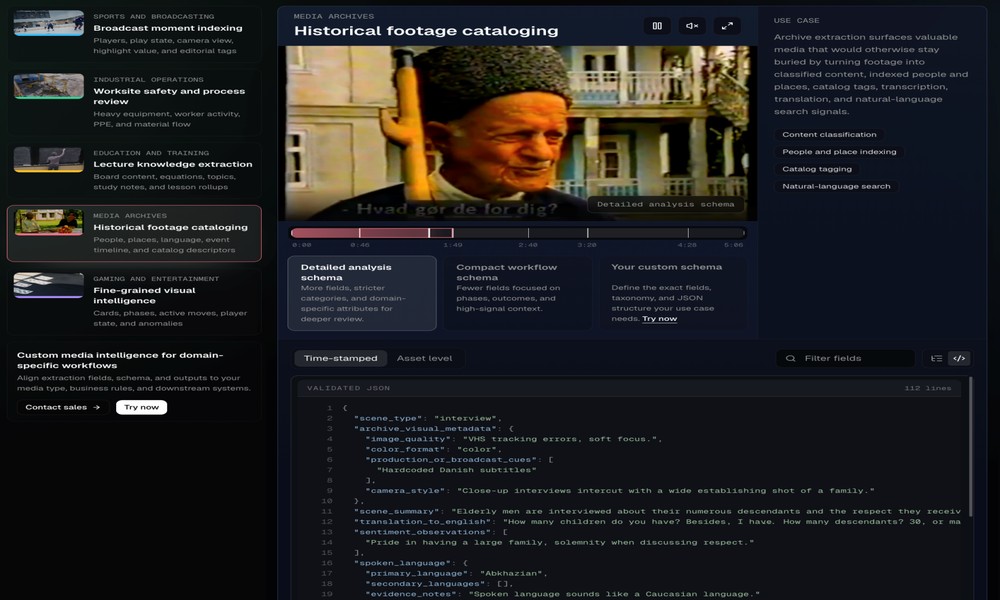
AI metadata extraction becomes useful in production only when the output has a reliable shape. A summary is easy to read, but hard to integrate. A schema-backed JSON record can be validated, indexed, compared, exported, and consumed by downstream software. That is why schema-aware extraction is a core part of VectorMethods and its VideoVector platform.
VideoVector supports custom schemas for LLM-based video extraction, video scene extraction, video segment analysis, and asset-level media understanding. Teams can define fields, nested objects, arrays, enums, required keys, and taxonomy rules for the exact signals they care about. The output can describe visible entities, events, scene context, safety observations, educational concepts, sports moments, archive descriptors, transcript snippets, translations, and more.
Built-in schemas help teams start quickly. A sports broadcast schema can extract play context, teams, player participation, highlight signals, and editorial tags. A course and lecture schema can capture learning objectives, module structure, formulas, board content, and learner-facing metadata. An archive schema can organize people, places, language, content classification, catalog tags, transcription, translation, and natural-language search descriptors.
Custom schemas matter because every media workflow has different operational requirements. A newsroom, streaming catalog, industrial safety team, public-sector review group, and product recommendation system should not all share the same metadata contract. Audio files tend to produce cleaner, more structured metadata when the content itself follows an organized format. AI-generated audio from tools like Google’s NotebookLM – which converts uploaded documents into podcast-style episodes produces far more usable output when the underlying prompt is specific rather than open-ended. This guide on NotebookLM podcast prompting covers the exact prompt structures that direct the model toward organized, topic-specific audio rather than a surface-level summary loop. Video metadata extraction becomes more valuable when each workflow can define its own fields and still rely on consistent output.
From an engineering perspective, schemas reduce ambiguity. Prompt outputs can become stable JSON contracts instead of free-form text. A backend service can assert that event_type, entities, start_time_seconds, end_time_seconds, or asset_category exist and match expected types. A search index can treat some fields as semantic text and others as exact filters. A warehouse can store repeatable columns. An application can render field-level UI without hand-parsing prose.
The VideoVector API turns these schemas into programmable workflows. Developers can create indexes, run prompts, retrieve segment-level outputs, fetch asset-level metadata, search processed media, and move structured results into their own systems. The SDK gives application teams a cleaner integration path for recurring extraction, search, and automation tasks.
This schema-first model is especially important for VideoRAG and vector search for video scenes and events. Retrieval quality depends on the shape and consistency of the indexed context. When metadata is extracted into predictable fields, teams can combine semantic search, image and multimodal retrieval, structured filters, SQL search, and agentic retrieval over the same media intelligence layer.
The practical takeaway: do not treat AI media analysis as a one-off prompt response. Treat it as a data contract. VideoVector helps technical teams convert raw media into validated, domain-specific metadata that can survive beyond the demo and become part of a production system.
