


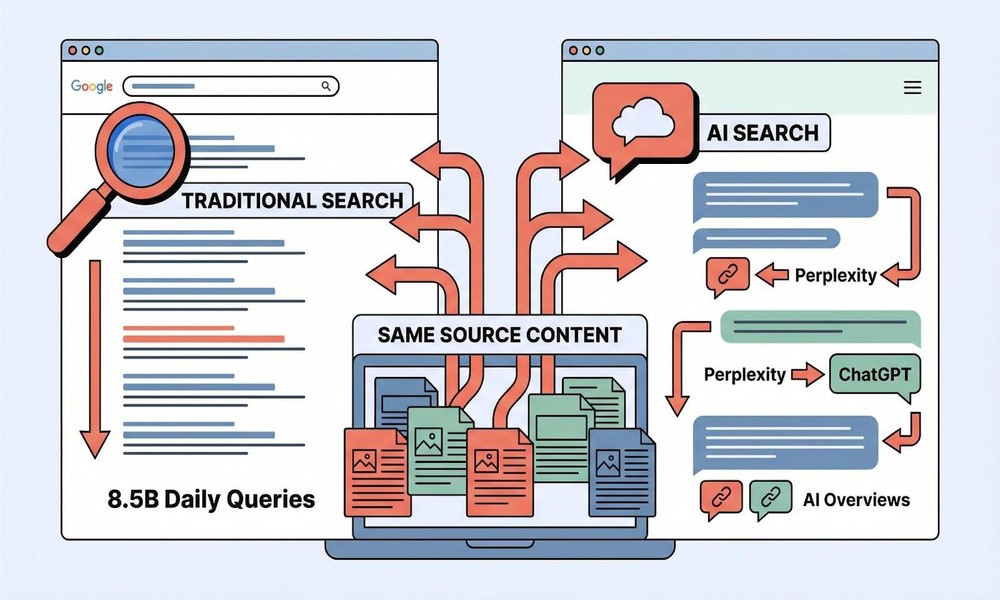
Perplexity. ChatGPT. Google AI Overviews. Every month there’s a new prediction that traditional search is dead. Meanwhile, Google still processes over 8.5 billion queries a day and organic click-through rates on page-one results haven’t collapsed.
The real story is more nuanced than “SEO is dead.” AI search is additive, not replacement. And the companies winning in AI search are the same ones winning on page one. Here’s why.
The “SEO Is Dead” Narrative Gets It Wrong
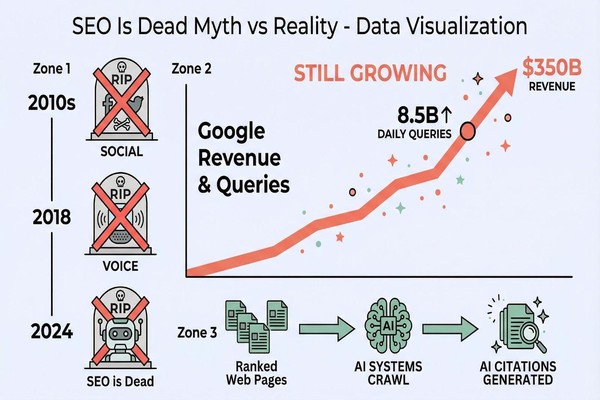
This narrative resurfaces every few years. Social media was supposed to kill search. Voice assistants were supposed to kill search. Now AI is supposed to kill search. Google’s revenue hit $350 billion in the last fiscal year. Search isn’t dying.
What’s changing is where answers appear. AI Overviews pull content into the SERP itself. Perplexity and ChatGPT synthesize answers from web sources. But here’s what most commentators miss: these systems need source material. They cite web pages. They pull from indexed content. They reward the same signals that drive traditional rankings.
If your content doesn’t rank, it doesn’t get cited. If it doesn’t get cited, you’re invisible in both traditional and AI search.
AI search didn’t replace page-one rankings. It added another reason to have them.
What AI Search Engines Actually Reward
Citation-Worthy Authority
Perplexity and ChatGPT don’t cite random blog posts. They cite pages with strong domain authority, clear expertise signals, and structured information. The same factors that drive Google rankings drive AI citations.
Structured, Crawlable Content
AI systems parse your content programmatically. Clean heading hierarchies, schema markup, and fast-loading pages make your content easier to extract and cite. A capable seo agency optimizes for both human readers and machine parsers simultaneously.
Depth Over Keyword Density
AI models evaluate topical coverage, not keyword repetition. Pages that answer a question thoroughly — with data, examples, and clear structure — get cited more often than shallow content optimized for a single phrase.
Freshness and Accuracy
AI search engines penalize stale content more aggressively than Google does. A page with outdated statistics or broken claims gets dropped from AI-generated answers fast. Your content library needs active maintenance, not publish-and-forget.
Multi-Format Presence
AI Overviews pull from videos, images, structured data, and text. Companies that diversify their content formats increase their surface area for citation across every AI platform.
How to Win on Page One and in AI Search Simultaneously
Audit your citation footprint. Search your brand and top keywords in Perplexity and ChatGPT. Note where you appear, where you don’t, and which competitors get cited instead. This is your AI search baseline.
Build content that answers, not just ranks. A page that ranks position three but doesn’t directly answer the query won’t get pulled into AI Overviews. Restructure your top pages so the core answer appears in the first 200 words, with supporting detail below.
Invest in E-E-A-T signals. Author bylines, cited sources, original research, and clear expertise markers all increase your chances of AI citation. These are the same factors Google has prioritized since the Helpful Content Update.
Optimize for multiple AI platforms. Google AI Overviews, Perplexity, ChatGPT, and SearchGPT each have different retrieval patterns. A forward-looking seo agency that covers traditional SEO alongside AI search optimization ensures you’re visible across all of them.
Monitor and refresh quarterly. AI search results change faster than traditional SERPs. Set a quarterly review cycle to update statistics, refresh examples, and fill new content gaps.
Sitting Out AI Search Is Not a Neutral Decision
Companies that stop investing in organic rankings because “AI will change everything” are making a bet against 8.5 billion daily queries. They’re also forfeiting their position in the AI search results that depend on those same rankings.
The numbers are already clear. Pages that rank in the top three on Google are four times more likely to be cited in AI-generated answers. Dropping off page one means disappearing from both channels at once.
Your competitors are not debating whether SEO still matters. They’re optimizing for traditional search and AI search at the same time. The window to build that dual presence is now — before the citation patterns harden and the cost to break in doubles.
